
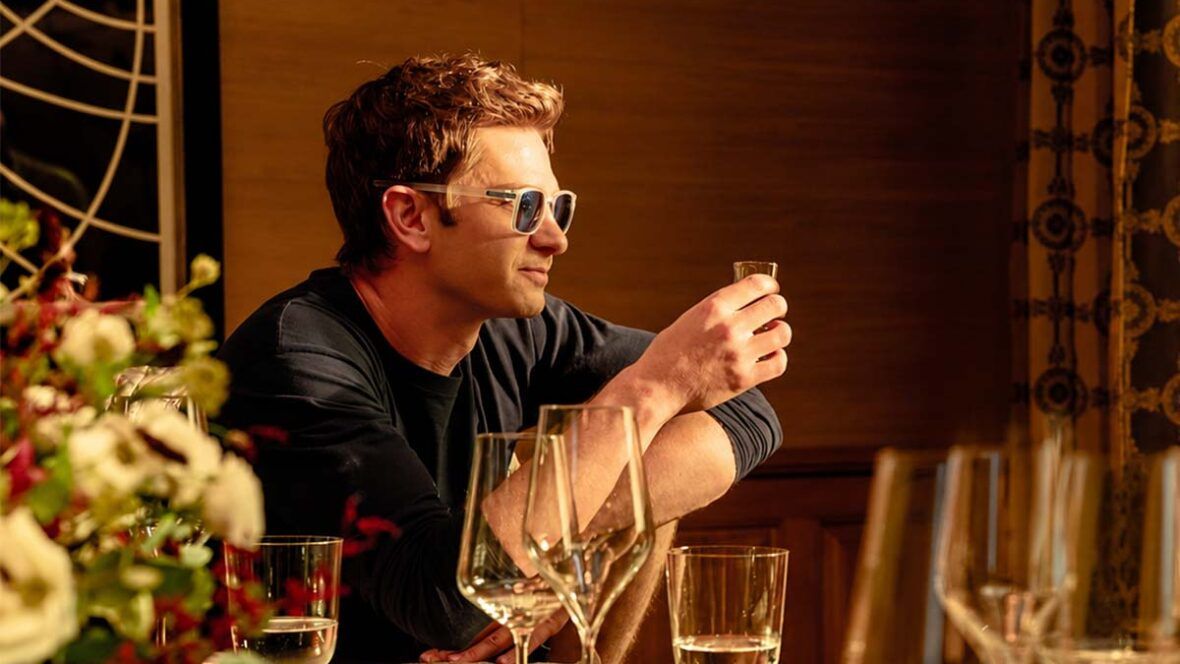
Andrew Garfield has returned to the uneasy territory where technology, ambition and personal loyalty collide. At the BFI London Film Festival premiere of Artificial, the actor said “curiosity and fear” guided his portrayal of OpenAI chief executive Sam Altman — a compact description of the tension Luca Guadagnino's new film is asking audiences to hold when it reaches cinemas on Christmas Day.
The project is one of the most closely watched studio dramas of the year because it turns a recent corporate crisis into a character-driven movie while the consequences of that crisis are still unfolding. Garfield plays Altman; Yura Borisov plays OpenAI co-founder and former chief scientist Ilya Sutskever; Monica Barbaro portrays former technology chief Mira Murati. Mark Rylance appears as pioneering computer scientist Geoffrey Hinton, while Ike Barinholtz takes on Elon Musk.
Reuters reported that the film moves across roughly two decades of artificial-intelligence research before arriving at the five-day leadership struggle that briefly removed Altman from OpenAI in November 2023 and then returned him to the top job. The result is not a distant historical account. It is a Hollywood interpretation of a dispute whose participants, institutions and public arguments remain active in the world outside the cinema.
A PREMIERE BUILT FOR BOTH SIDES OF THE ATLANTIC
Artificial had its world premiere at the New York Film Festival on October 5, then crossed the Atlantic for a gala screening at London's Royal Festival Hall on October 11. That route gave the film an unusually precise launch: first before an American audience accustomed to Silicon Valley power stories, then before a British festival crowd viewing the same events from outside the US technology industry.
The London appearance brought Garfield, Borisov, Barbaro, Rylance, Barinholtz and Guadagnino together on the carpet. It also allowed the cast to address the obvious challenge hanging over the production. A movie can spend years developing, shooting and editing; the technology sector it depicts can change its public face in a week. Barbaro told Reuters that the truth around the figures they were playing seemed to shift month by month, making the work exciting but daunting.
That instability is not merely a publicity complication. It is central to the film's dramatic appeal. Most corporate biographical movies benefit from hindsight: viewers know which company survived, which executive prevailed and which innovation mattered. Artificial arrives before the larger story has settled. Its audience knows the 2023 boardroom outcome, but not what the decisions made around that crisis will mean a decade from now.
GARFIELD PLAYS AN IDEA OF SAM ALTMAN, NOT A FINAL VERDICT
Garfield said he did not meet or contact Altman while preparing for the role. Instead, he approached the performance with empathy for a contemporary figure being dramatized in public. That choice matters. It suggests the film is less interested in offering an authorized impersonation than in using Altman's position to examine the personality required to lead a company promising — and warning of — world-changing technology.
The actor also framed scrutiny as necessary. People should understand who holds power and who is helping create what he called “our new world,” he told Reuters. The wording captures a productive contradiction: Garfield can recognize courage, imagination and resilience in technology leaders while still believing they deserve a searching public examination.
Altman has signaled his own distance from the movie. Reuters noted that he told Vanity Fair he was not expecting an accurate depiction. OpenAI did not respond to the news agency's request for comment. Those facts are important guardrails for viewers. Artificial is a scripted drama, not testimony, and the presence of recognizable names does not convert every scene into an independently verified record.
THE SOCIAL NETWORK ECHO IS IMPOSSIBLE TO MISS
Garfield's casting carries a deliberate cultural echo. In 2010, he played Facebook co-founder Eduardo Saverin in The Social Network, another film about young men, explosive technology and a friendship fractured by ownership and control. Sixteen years later, he is no longer the wounded partner at the edge of the company. He is playing the executive at the center of the institution.
That reversal gives Artificial an extra layer for American audiences. The Social Network helped define how a generation imagined the birth of a social-media empire: fast, clever, lonely and legally combustible. The new film enters a different climate. The public no longer needs to be convinced that software companies can reshape daily life. The more urgent question is whether any small group of leaders can responsibly manage systems whose reach may exceed their own predictions.
Garfield's task is therefore more complicated than copying Altman's speech or posture. He must make strategic confidence legible without turning it automatically into villainy, and make uncertainty visible without softening the stakes. The performance has already generated awards-season discussion after festival screenings, but Garfield told Parade he tries to keep that attention in perspective and focus on work he can be proud of.
YURA BORISOV MAKES THE CONFLICT A TWO-HANDED DRAMA
The movie's other central figure is Sutskever, played by Russian Oscar nominee Yura Borisov. Sutskever's path — from studying neural networks under Hinton to helping build OpenAI and participating in Altman's brief ouster — gives the story its intellectual and moral counterweight. The conflict is not simply between a chief executive and a board. It is between competing ideas about speed, safety, governance and who gets to decide when a powerful technology is ready.
That structure can keep the movie from becoming a conventional rise-and-fall biography. A single-protagonist version might invite audiences to judge Altman as visionary or opportunist and stop there. Centering Sutskever alongside him allows the disagreement itself to become the subject. The most consequential scenes are likely to be those in which reasonable people recognize the same risks and still reach incompatible conclusions.
Simon Rich, the Emmy-winning writer known for work on Saturday Night Live, wrote the screenplay. His presence points toward another necessary ingredient: humor. Technology culture has its own language, rituals and absurdities, and a film that treats every exchange as solemn prophecy would risk becoming as self-important as the institutions it studies. Guadagnino's challenge is to make boardroom procedure cinematic without losing the human vanity, fear and loyalty underneath it.
WHY ARTIFICIAL IS A TEST FOR HOLLYWOOD TOO
The film is arriving while studios are negotiating their own relationship with artificial intelligence. Actors, writers and craftspeople have spent years pressing for protections around digital replicas, training data and automated production tools. That makes Artificial more than a topical drama about a technology company. It is also a movie made by an industry deciding how much of its future should be entrusted to the technology on screen.
There is commercial risk in moving this quickly. A late factual development can make a scene feel dated before opening weekend. There is also creative value in refusing to wait for a neat ending. The 2023 leadership crisis became public theater because it exposed uncertainty at the top of a company presenting itself as a steward of transformative systems. Capturing that uncertainty while it is still culturally alive may be more revealing than polishing it into a settled legend years later.
The film's ensemble widens that frame. Barbaro's Murati sits inside the leadership transition rather than at its edges. Rylance's Hinton connects present-day conflict to decades of research. Barinholtz's Musk represents an earlier chapter in OpenAI's formation and the broader competition among powerful technology figures. Cooper Hoffman, Jason Schwartzman and Chris O'Dowd also appear, while Damon Albarn contributes original songs and score.
THE QUESTION AUDIENCES WILL CARRY OUT
Artificial opens on Christmas Day after premiering in New York and London, a release strategy that places it directly inside awards conversation while giving general audiences a holiday-season entry point. Its timeliness guarantees attention. Whether it lasts will depend on something harder: can it make the private dynamics of power compelling without pretending that a dramatic screenplay is the final account?
Garfield's emphasis on curiosity offers the right starting point. Fear alone would flatten the story into warning; admiration alone would turn it into corporate mythology. A film capable of holding both may help viewers see why the people building consequential systems can be ambitious, sincere, competitive and uncertain at the same time.
For the US, the movie is an argument about a homegrown institution whose products have become global. For the UK, its London gala places that argument inside a film culture already debating AI's effect on work and authorship. The story travels because the power it examines is not confined to Silicon Valley. The people in Artificial may be American technology leaders, but the world they are helping shape belongs to everyone watching.