
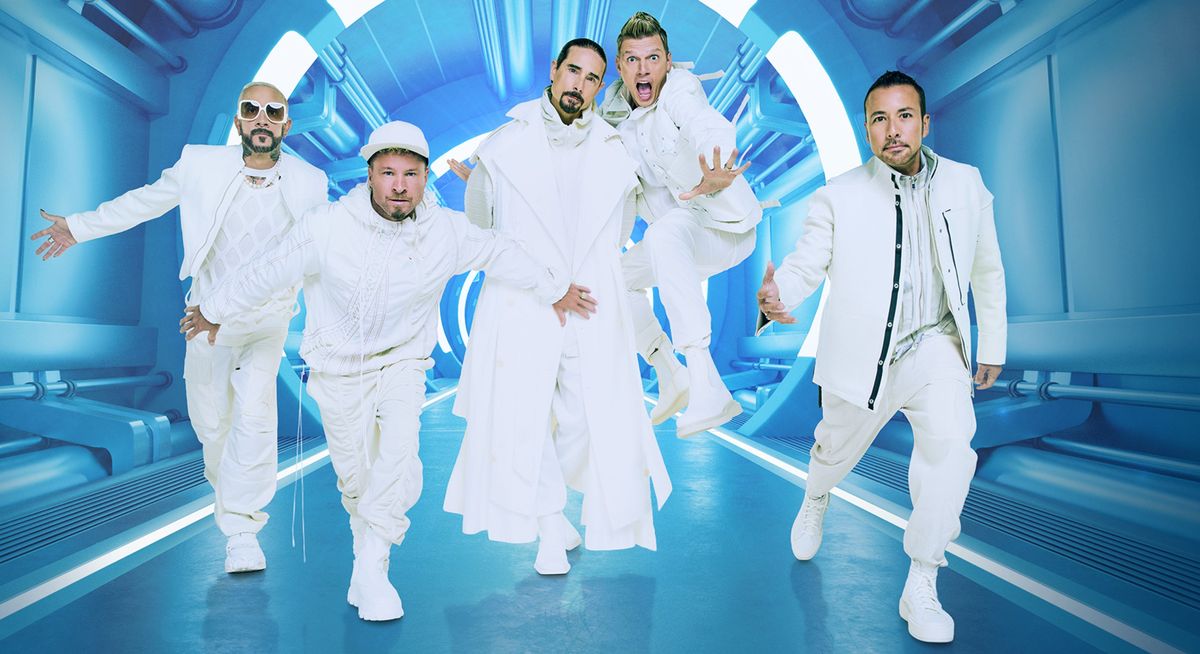
Backstreet Boys could be preparing to bring their Millennium revival to Britain. A report first carried by The Sun and subsequently picked up by several entertainment outlets says the five-piece are planning UK concerts for 2027, including a date at London’s O2 Arena tied to the venue’s 20th-anniversary celebrations.
The important word, for now, is planning. Neither the band nor The O2 has formally announced a UK tour, and no dates, ticket prices or on-sale details have been released. That distinction matters in a market where an early report can quickly be mistaken for a confirmed itinerary. What is credible is the direction of travel: the group have spent the past two years rebuilding Millennium as a large-scale live experience, first at Sphere in Las Vegas and most recently at Merkur Spiel-Arena in Düsseldorf.
If the proposed shows move ahead, they would mark Backstreet Boys’ first British performances since the DNA World Tour reached London and Manchester in November 2022. The London date would also return Nick Carter, Howie Dorough, AJ McLean, Brian Littrell and Kevin Richardson to The O2, where they played on November 6 during that tour.
WHY A UK RETURN NOW MAKES SENSE
The timing is less surprising than the secrecy. Into the Millennium began as an unusually ambitious catalogue show built around the group’s defining 1999 album, but its commercial life has extended well beyond a short nostalgia engagement. Backstreet Boys became the first pop act to headline Sphere when the production opened in Las Vegas in July 2025. The show returned for more dates in 2026, using the venue’s wraparound screen and scale to turn familiar songs into a fully immersive production rather than a conventional greatest-hits concert.
That run offered proof that the audience for late-1990s pop is not simply sentimental; it is large, international and willing to travel. The Düsseldorf residency made the point even more emphatically. The band played ten stadium shows between September 25 and October 7, 2026. Pollstar reported, citing Live Nation GSA, that the run sold 470,000 tickets in total and was sold out across all ten nights.
Those figures give any prospective UK promoter a clear signal. A London arena is considerably smaller than a ten-night German stadium engagement, while The O2 is already familiar territory for the group and its fans. A 2027 booking would also fit naturally into the arena’s anniversary calendar: the venue opened in its current form in 2007 and will mark 20 years next year.
The report points to concerts rather than a single commemorative appearance, suggesting that London may be the centrepiece of a broader British run. But until an official announcement arrives, fans should resist assuming which cities will be included. Manchester would be an obvious candidate because the band played AO Arena in 2022, yet no venue beyond The O2 has been credibly named in the reporting reviewed for this article.
A BRITISH AND EUROPEAN STORY THAT CAME BEFORE AMERICA
For UK listeners, a Backstreet Boys return carries more history than the easy label of a 1990s revival suggests. The group formed in Orlando in 1993, but their first sustained breakthrough did not happen in the United States. Europe embraced them first. Early singles gained traction across the continent, and Britain’s pop press and television culture helped establish the five singers as a new international act before American radio fully caught up.
Germany was particularly important. The band’s official materials describe Düsseldorf as a homecoming because that market gave them their first platinum record in 1996 during the era of “I’ll Never Break Your Heart.” Brian Littrell described Germany as the place where the band’s “dream became a reality,” saying the homecoming shows brought the story full circle. Thirty years later, the 2026 German residency did exactly that: the group returned to one city for ten nights with a show built around the album that later made them global superstars.
The United Kingdom became an equally durable part of the story. Backstreet Boys built a British audience through singles, television appearances and touring at a time when boy-band competition was intense and pop fandom moved quickly. Their appeal survived changes in fashion because the records combined polished choreography with five distinct vocal personalities. Ballads such as “I’ll Never Break Your Heart” and “Show Me the Meaning of Being Lonely” gave the group emotional weight, while “Everybody (Backstreet’s Back)” and “Larger Than Life” became precision-built arena songs.
That mix still shapes the live show. It also explains why a UK return can appeal to more than one generation: original fans now bring family members who know the choruses through streaming, films, television and social media. The songs have never really disappeared; the audience around them has simply widened.
THE MILLENNIUM ALBUM STILL SETS THE SCALE
Released in May 1999, Millennium arrived at the peak of the teen-pop boom and helped define it. The album opened with 1.13 million US sales in its first week, then a record for the SoundScan era, and spent ten non-consecutive weeks at No. 1 on the Billboard 200. Its four singles included “I Want It That Way,” a song whose instantly recognisable opening and five-part delivery became shorthand for an entire pop moment.
The album’s longevity is not based on one hit alone. “Larger Than Life” converted fan devotion into an outsized opening statement; “Show Me the Meaning of Being Lonely” placed the group’s harmonies inside a darker, more reflective arrangement; and “The One” demonstrated the melodic clarity that made the record so durable. Millennium earned five Grammy nominations and became one of the best-selling albums of its era.
The current production treats that legacy as material to be restaged rather than merely replayed. In Düsseldorf, the show opened with the members descending above the stadium on individual platforms shaped like surfboards, a deliberate reference to the flying-board entrance from the original 1999 tour. The 26-song set then moved beyond the album to cover earlier European favourites and later hits, presenting the group’s history as one continuous catalogue.
That balance is likely to be crucial if the show reaches Britain. A UK arena audience will expect the Millennium centrepiece, but it will also expect the songs that established the group in Europe before that album and the later singles that sustained their career. The current format is already built to satisfy both demands.
WHAT FANS CAN EXPECT — AND WHAT THEY SHOULD NOT DO YET
The Las Vegas and Düsseldorf versions provide a useful guide to the scale of a possible London show: elaborate video design, tightly rehearsed choreography, close-harmony vocals, costume changes and a set list that treats the late 1990s as the dramatic centre without ending the story there. The O2 cannot reproduce Sphere’s architecture, but the German stadium production shows that Into the Millennium can be adapted to a more conventional venue while retaining its theatrical identity.
Fans can also expect demand to be intense if the report becomes an announcement. The German run’s sales and the continuing appetite for Sphere dates suggest that premium seats, fan-club presales and travel packages could move quickly. None of those products exists for the reported UK shows yet, however. Any website claiming to offer official London tickets before the band, venue or authorised promoter publishes details should be treated cautiously.
The safest course is straightforward: watch the band’s official channels and The O2’s own listings, and wait for a dated announcement naming the promoter and authorised ticket seller. A rumour can be well sourced and still change before contracts and schedules are finalised.
For now, the report is best understood as a strong sign rather than a completed booking. Backstreet Boys have a proven production, a recently completed European stadium run and a deep connection with British audiences. The O2 has an anniversary to celebrate, and the band have not played the UK in nearly five years. Those pieces fit neatly together. The next step — dates on a calendar and tickets on sale — must still come from the people actually staging the shows.