
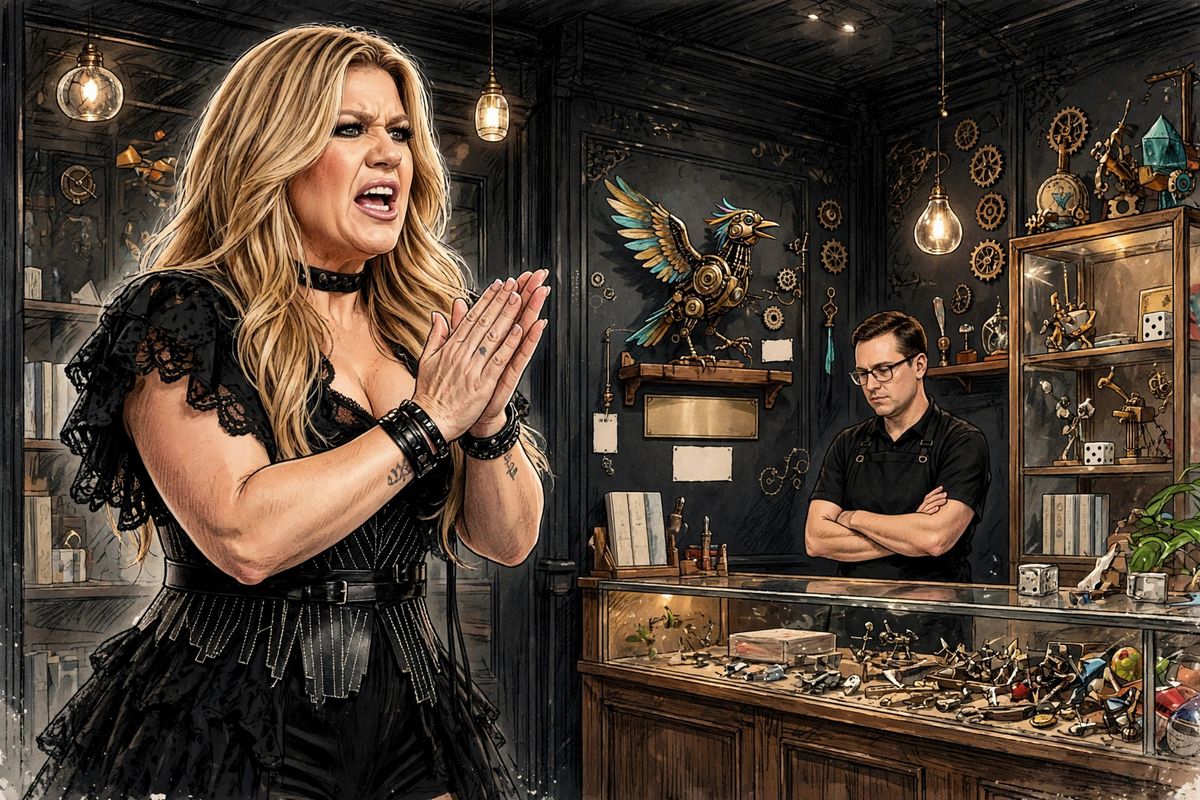
A brief shopping visit to a Brooklyn curiosity shop has turned into an unusually public dispute between Kelly Clarkson and Art of Play, with the two sides offering sharply different accounts of a conversation about a mechanical bird. What began as the singer's complaint about feeling judged now hinges on a narrower factual question: was the particular automaton she admired available to buy, or was a similar one being discussed instead?
Clarkson first described the encounter on X on Saturday after visiting Art of Play in Brooklyn Heights. She said she had made the trip because the store looked interesting and she had several purchases in mind. According to her post, an employee looked her over, treated her as though she could not afford the item and offered to locate something comparable. She compared the experience to the luxury-boutique rejection scene in Pretty Woman, the 1990 film in which Julia Roberts' character is dismissed by sales staff before returning as a customer with money to spend.
THE STORE'S SUNDAY RESPONSE
Art of Play answered on Instagram on Sunday. The shop identified the object as Molly, a one-of-a-kind singing-and-dancing bird automaton used in its magic shows. Its statement said Molly is fixed to the wall and not available for purchase. At the same time, the business acknowledged why Clarkson's description of feeling judged would resonate with shoppers and stressed that browsers and paying customers are meant to receive the same welcome.
The store also described the online response as overwhelming. Clarkson has millions of followers, and Art of Play said it had suddenly become the target of criticism from people who had never visited. That point matters because a celebrity complaint can transform a five-minute exchange into a reputational crisis for a small business before either side has had time to establish a shared version of events. It also does not, by itself, settle what happened inside the shop.
CLARKSON DISPUTES THE EXPLANATION
Clarkson rejected the store's central claim later on Sunday. She said she had pointed to a price label for a singing bird and asked whether it was for sale. In her account, the employee looked her up and down — she used the phrase “elevator-eyed” — then named a price of $15,000 and suggested finding something comparable. Her conclusion was blunt: “So you're not only rude, you're also a liar.”
The disagreement is therefore not really about whether Art of Play owns a mascot called Molly. Both sides agree that Clarkson asked about a mechanical bird and that a $15,000 figure entered the conversation. The conflict is over what that figure referred to, how the alternatives were explained and whether the employee's tone communicated practical information or condescension. Those details are difficult to reconstruct from dueling social-media posts, but they explain why neither account has satisfied the other.
Clarkson also pushed back on the suggestion that her criticism was hostile to small businesses. Her stated reason for entering the store was to support one. She argued that independent ownership does not excuse making a customer feel lesser, and framed the dispute as a question of ordinary courtesy rather than celebrity privilege. That distinction is central to her case: she is not saying every display must be sold, but that a shopper asking a reasonable question should not be judged by appearance or presumed spending power.
A MONDAY CLARIFICATION ADDS CONTEXT
Early Monday, Art of Play offered a more detailed explanation. The store said Molly remains permanently attached to the wall as a de facto mascot, but that the artist who creates the machines, Seattle-based Bliss Kolb, owns a nearly identical automaton and was willing to sell that piece for $15,000. The shop also said it had offered to show Clarkson another singing-bird automaton, made by a traditional German clockmaking workshop and priced at about $2,000, but that she left before seeing it.
That clarification gives the $15,000 figure a possible source without conceding that Molly herself carried a sale price. It also reveals how easily the exchange could have fractured. A customer pointing at one object may hear a quoted price as the price of that object; a specialist retailer may believe it is clearly discussing a related work by the same maker. If the conversation was hurried or the tone felt dismissive, the distinction between “this bird” and “a twin of this bird” could disappear in seconds.
The store said it had contacted Clarkson directly and hoped the parties could clear the air. As of the reports published Monday, there was no public sign that they had reconciled. Clarkson's representative had not immediately responded to Page Six's request for further comment, leaving the social posts as the clearest record of each side's position.
WHY THE EXCHANGE TRAVELLED SO FAR
The dispute spread because it combines several familiar internet flashpoints: celebrity reach, small-business vulnerability, class assumptions and the ambiguity of a conversation without an independent record. Clarkson's Pretty Woman comparison supplied an instantly recognisable cultural frame. Most people have either felt underestimated in a shop or worried that a brief misunderstanding could be stripped of context online. That made the story emotionally legible long before the mechanics of antique automata became clear.
There is also a lesson here about the speed of reputation. Clarkson's first post presented a vivid personal experience. The store's response tried to protect the identity of an object that functions as part of its performances. The singer then treated that explanation as a revision of what she had been told. By Monday, Art of Play was explaining the provenance and price of a second bird to a global audience. Each new statement narrowed one question while opening another.
For readers, the fairest conclusion is also the least dramatic: the public evidence supports that Clarkson felt judged and that Art of Play says its employee was explaining alternatives to a display piece. It does not provide an independent transcript capable of proving tone or intent. The store's later description may explain the competing price references, but it cannot erase how Clarkson says the exchange felt in the moment. Her account, meanwhile, cannot establish what the employee intended.
What the episode does establish is how costly a poorly handled retail conversation can become. Clear language would have helped: this exact bird is part of the show, while its maker has a twin available for $15,000. So would a tone that left no room for a customer to believe that price was being used as a warning. In a specialty shop built around wonder, the most consequential performance of the weekend may have been the everyday art of making a visitor feel welcome.