
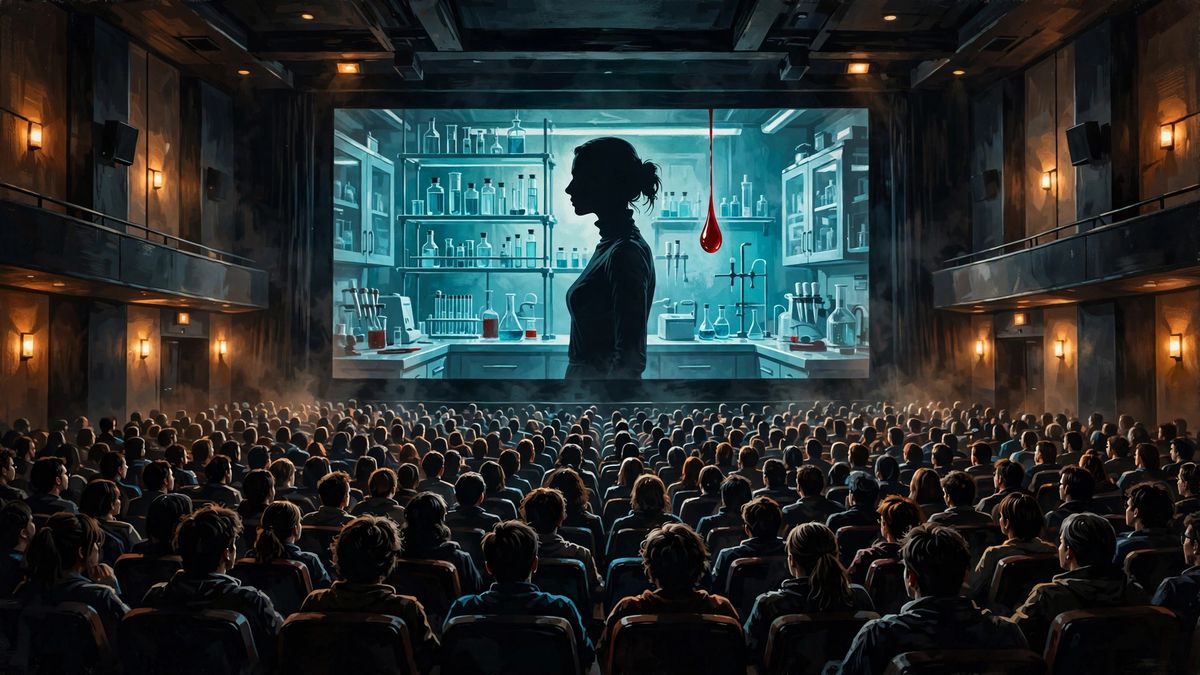
LOS ANGELES — Every rule of the modern box office says this was not supposed to happen. Documentaries open quietly, build slowly and find their real audience on streaming. Three-hour documentaries about convicted fraudsters are supposed to do even less. Instead, A24's “You Can See Everything” — a three-hour film about disgraced Theranos founder Elizabeth Holmes, directed by Nathan Fielder and Lance Oppenheim and developed in near-total secrecy over three years — has walked into North American cinemas and beaten a studio video-game blockbuster at the top of the daily chart.
On Monday, the film topped the box office with $2.57 million. Behind it sat Paramount and Legendary's “Street Fighter” reboot, which took in $2 million the same day. The comparison is the story: “Street Fighter” is playing in 3,575 theaters across North America. “You Can See Everything” reached number one from a fraction of that footprint — the kind of weekday hold usually associated with franchise sequels and animated family hits, not with a three-hour nonfiction film about the collapse of a blood-testing empire.
AN OPENING WEEKEND FOR THE RECORD BOOKS
The Monday crown capped an opening weekend that had already left box-office watchers reaching for superlatives. Playing on just 855 screens, the film opened to $15 million, with more than 2,000 showings selling out across its first three days. That is the strongest opening for a film on fewer than 1,000 screens since 2006 — a per-screen average of roughly $17,500 that most wide releases would envy — and it makes “You Can See Everything” the highest-grossing debut for a non-music documentary in two decades.
Numbers like those are not a ceiling; they are a queue. A $15 million opening built on thousands of sellouts means demand was turned away at the door, and A24 has responded the way distributors do when a film catches fire: it is expanding the screen count, pushing the documentary into more theaters after the sellouts made clear that the opening footprint was far too small for the audience that showed up.
THE SECRET FILM WITH THE PERFECT SCORE
Part of the frenzy was engineered long before a single ticket was sold. Fielder and Oppenheim developed the film in secrecy over three years — a remarkable act of confidentiality in an industry that leaks as a matter of course — and then unveiled it in a surprise premiere at the Telluride Film Festival. The unveiling worked twice over: first as a genuine shock for festival audiences, and then as a critics' phenomenon. The film holds a 99% rating on Rotten Tomatoes and a matching 99% on Metacritic, a near-unanimity that is rare for any release and almost unheard of for a documentary about a subject as contested as Elizabeth Holmes.
Holmes remains one of the most magnetic figures in modern American business infamy. A Stanford dropout who founded Theranos as a teenager, she promised to revolutionize medicine with machines that could run hundreds of tests from a few drops of blood — and Silicon Valley believed her. Theranos was valued in the billions, and Holmes became, for a time, the face of a certain kind of startup genius. Then the technology was exposed as not working as claimed, the company collapsed, and Holmes was convicted of defrauding investors and sentenced to prison. Books, podcasts, investigations and a dramatized series have all taken their turn at the story since. What none of them could do is what a great documentary can: hold an audience in a dark room, for three hours, with the woman herself.
THE FIELDER EFFECT
If the subject explains the curiosity, the director explains the crowds. In an audience poll conducted by A24, a remarkable 70% of those surveyed said Nathan Fielder was a major reason they bought a ticket. The opening-weekend audience skewed strikingly young — 70% of it under the age of 35 — a demographic signature that maps almost exactly onto the devoted following Fielder built with “Nathan for You” and “The Rehearsal,” two of the most obsessively discussed series of the streaming era.
That following behaved the way modern fanbases do: it treated the release as an event. The sellouts became part of the story — scarcity feeding urgency, urgency feeding the sense that this was a film to be seen in a cinema, with strangers, before someone spoiled it. And there is an irony Fielder would presumably appreciate. A performer famous for constructing elaborate artificial scenarios has scored his biggest success by pointing a camera at one of the great real-life performances of the century: Holmes' own.
DAVID, MEET GOLIATH
None of this means “Street Fighter” failed. The reboot led the weekend overall with a $31 million domestic opening across its 3,575 theaters and $51 million globally — a respectable launch for a video-game adaptation, and a reminder that in absolute terms the blockbuster remains the bigger commercial property. What Monday's chart captured was trajectory. Franchise openings are front-loaded: the faithful arrive on day one, and the grosses fall away fast. “You Can See Everything,” powered by reviews, sellouts and word of mouth, is moving in the opposite direction — and the daily chart rewards momentum.
The economics are even more lopsided than the rankings. The documentary was made for just $7 million, which means its opening weekend alone returned more than twice its production budget — before a single international ticket, premium screen or streaming deal is counted. Very few releases of any genre, in any year, can say that.
WHAT HAPPENS NEXT
The film's next milestone is already in view. By next weekend, “You Can See Everything” is set to pass “Won't You Be My Neighbor?” — the beloved portrait of Fred Rogers — to become the highest-grossing documentary of the past ten years. With A24 widening the release, the ceiling keeps rising, and there is a template close at hand: Oppenheim's other A24 release this fall, “Primetime,” passed $45 million domestically after four weekends — the kind of long, word-of-mouth-driven run this distributor has turned into a house specialty. A similar trajectory for the Holmes film no longer looks like a fantasy.
Even the subject's inner circle has been pulled into the conversation. Holmes' husband, Billy Evans, discussed the film publicly at the All-In Summit 2026 — another sign of how completely the documentary has escaped the film pages and entered the wider business and culture conversation, a conversation Holmes herself never really left.
Step back, and the weekend amounts to a small referendum on what theatrical moviegoing still does best. A secret film, a disgraced subject, a director whose fans trust his instincts absolutely, and notices as close to perfect as notices get: none of it was franchised, focus-grouped or guaranteed by an algorithm. It was an event — and on Monday, in the only chart that records what Americans actually chose to watch that day, the event beat the blockbuster. Hollywood has spent a decade asking what could persuade young audiences to leave their sofas. This week, 855 screens at a time, it got its answer.
Source note: This original BuzzDaily report is based on TheWrap's reporting of 20 October 2026 (“'You Can See Everything' Tops Monday Box Office”) and Zoom TV Entertainment's weekend box-office report, including the opening and Monday grosses, screen counts, sellout figures, the A24 audience poll, the Telluride premiere, the film's review scores and its planned expansion. Background on Theranos and Elizabeth Holmes is a matter of widely documented public record; the analysis is BuzzDaily's own.