
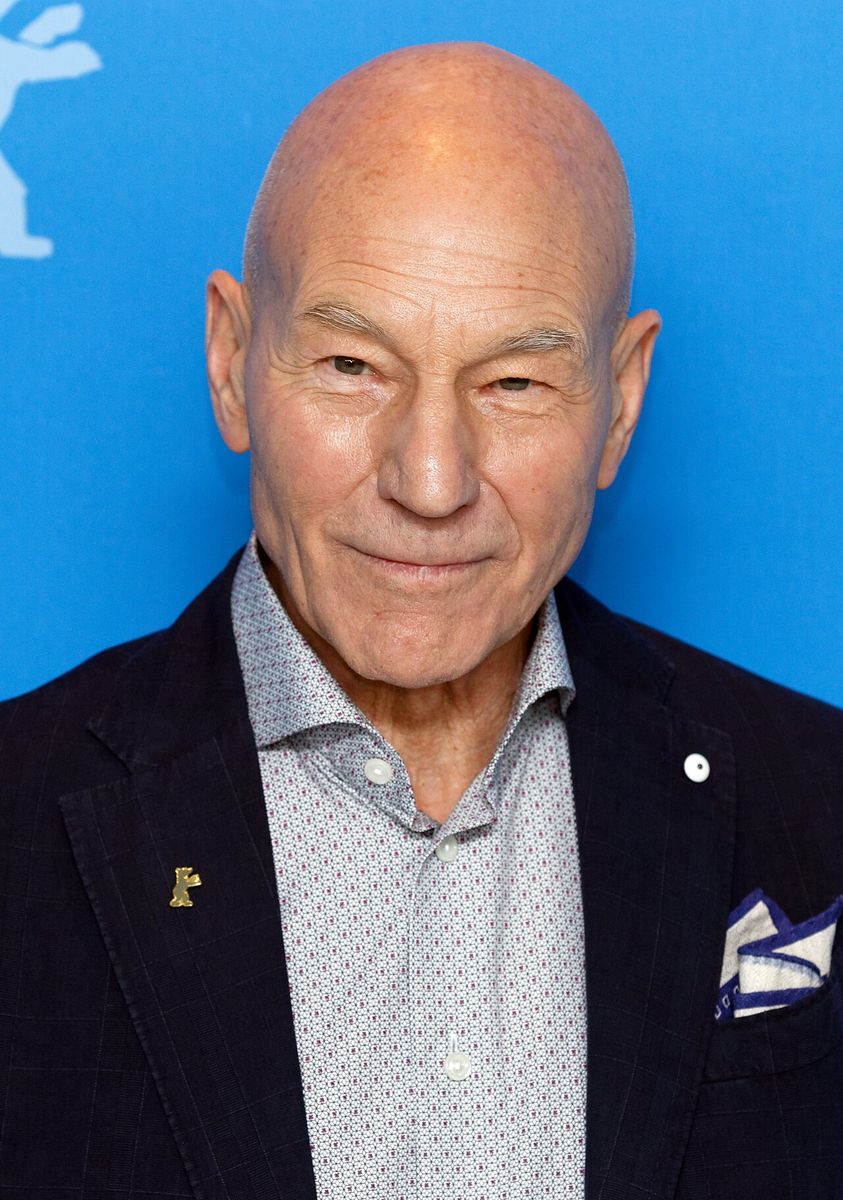
LOS ANGELES — Sir Patrick Stewart, the Yorkshire-born stage actor who became one of the most beloved screen performers of his generation — Captain Jean-Luc Picard to Star Trek audiences, Professor Charles Xavier to X-Men fans — died on Wednesday, 28 October, at his home in Los Angeles. He was 86.
The news was announced in a statement posted to Stewart’s official social media on Thursday, 29 October. His spokesperson, Kelly Bush Novak, said the actor had been through “a brief and poignant journey with Alzheimer’s Disease and Lewy Body Dementia” — two diagnoses that, until the announcement, had never been publicly disclosed. For a man whose clarity of mind and precision of voice defined his art for more than sixty years, the revelation landed with a particular sadness among the millions who had grown up listening to him.
According to the statement, Stewart died “in the loving care of his beloved wife Sunny” — the musician Sunny Ozell, his third wife — “held in the warm embrace of family and friends, surrounded by live music, prayer, tears, laughter.” It is, by any measure, the kind of farewell his admirers would have wished for him: at home, among the people he loved, with music in the room. He is survived by Sunny and by his two children, Daniel and Sophie, from his first marriage, to Sheila Falconer.
FROM MIRFIELD TO THE ROYAL SHAKESPEARE COMPANY
Patrick Stewart was born on 13 July 1940 in Mirfield, West Yorkshire — a long way, in every sense, from the bridge of the starship Enterprise. His mother, Gladys, was a textile worker; his father, Alfred, was a regimental sergeant major. The route out of Mirfield began, improbably, at a local newspaper, where the young Stewart worked before winning a scholarship to the Bristol Old Vic Theatre School, the training ground that turned a mill-town boy into a classical actor.
At 26 he joined the Royal Shakespeare Company, and he spent much of the 1960s there, learning his craft in the most demanding repertory in the English-speaking theatre. It shows in everything that followed. The diction, the stillness, the sense that a line of dialogue was something to be weighed before it was spoken — all of it was formed on those stages, years before television made his face famous around the world.
Those who worked alongside him often traced the later fame back to that discipline. Stewart treated genre material — starships, mutants, captains’ logs — with exactly the seriousness he gave Shakespeare, and refused to condescend to it. It is a large part of why the work lasted: audiences can tell when an actor believes in the world he is standing in, and Stewart always believed.
THE CAPTAIN WHO ARRIVED AT 47
Fame, when it came, came late and from an unlikely direction. Stewart was 47 when he was cast as Captain Jean-Luc Picard in Star Trek: The Next Generation, the cerebral, diplomatic starship captain at the centre of the revived Star Trek universe. The series ran from 1987 to 1994 — 176 episodes across seven seasons — and turned a British theatre actor, largely unknown to American audiences, into a global figure.
Picard could so easily have been a footnote: the stern successor to William Shatner’s Kirk. Instead, Stewart made him the moral centre of the franchise — a leader who preferred negotiation to phasers, who treated the unknown as something to be understood rather than conquered. Four feature films followed between 1994 and 2002, and a generation later he returned to the role in Star Trek: Picard (2020–2023), playing the captain as an old man reckoning with time, loss and unfinished business. Few actors get to bookend a character across thirty-five years. Stewart did it without ever cheapening him.
There is a reason Picard endures in a way few television characters do. Stewart played him as a man whose first instinct was curiosity and whose second was conscience — and he played him that way in an era when screen heroes were more often defined by firepower. The performance quietly rewired what a leading man in science fiction could be.
PROFESSOR X, AND A FRIENDSHIP FOR THE AGES
In 2000, Stewart took on a second role that would define him for another vast audience: Professor Charles Xavier, the serene founder of the X-Men, in Fox’s X-Men films. He played Xavier opposite his close friend Ian McKellen as Magneto — two Shakespearean knights facing each other across a superhero chessboard, one arguing for coexistence, the other for defiance — in X-Men (2000), X2: X-Men United (2003) and X-Men Origins: Wolverine (2009), before a valedictory turn in Logan (2017), which let him play the professor as frail, frightened and heartbreakingly human.
The run earned Stewart a place in the record books: the Guinness World Record for the longest Marvel career. And it is not quite over. Xavier will be seen once more, posthumously, in Avengers: Doomsday — a final appearance that will now arrive as something closer to a farewell.
A KNIGHT OF THE THEATRE
Honours followed the work. Stewart was knighted by Queen Elizabeth II in 2010, for services to drama — a formal recognition of a career that had never really left the stage behind, even at the height of his screen fame. To theatre audiences he remained, first and always, a company actor: the RSC training visible in every pause, and that voice — perhaps the most recognisable instrument in British acting — deployed as readily for kings and captains as for comedy and animation.
‘AN ABSOLUTE LEGEND’: THE TRIBUTES
The tributes arrived within hours, and they crossed every world Stewart had inhabited. Hugh Jackman, his X-Men co-star, remembered him as a mentor and a friend. William Shatner, Star Trek’s original captain, posted on X. Ian McKellen recalled their deep friendship — a bond that long outlasted the films and became one of the most public and joyful friendships in British theatre. Simu Liu called the passing “devastating” and Stewart an “absolute legend.” Seth MacFarlane posted a lengthy tribute; Stewart had voiced CIA Deputy Director Bullock on American Dad for years, gleefully sending up his own gravitas. Marvel Studios honoured him, and the late Stan Lee’s Instagram account shared a tribute of its own.
A HARD WEEK FOR STAR TREK
Stewart’s death came in a week of compounded loss for Star Trek. Walter Koenig, who played Pavel Chekov in the original series, also died this week, aged 90. Within days, the franchise lost both its original navigator and the captain who carried it into its modern era — two men who, between them, spanned the whole history of the final frontier on screen.
What Stewart leaves behind is unusual: not one defining role but two, in the two biggest science-fiction franchises of the modern era, each played with the same intelligence and restraint he first brought to Shakespeare. He made authority look like a form of kindness. For audiences in Britain, where he began, and in America, where he found his widest fame, the loss feels personal in a way few actors’ deaths do — because for nearly forty years, in one uniform or another, he was the calm voice in command of the ship. He is survived by his wife, Sunny, and his children, Daniel and Sophie.