
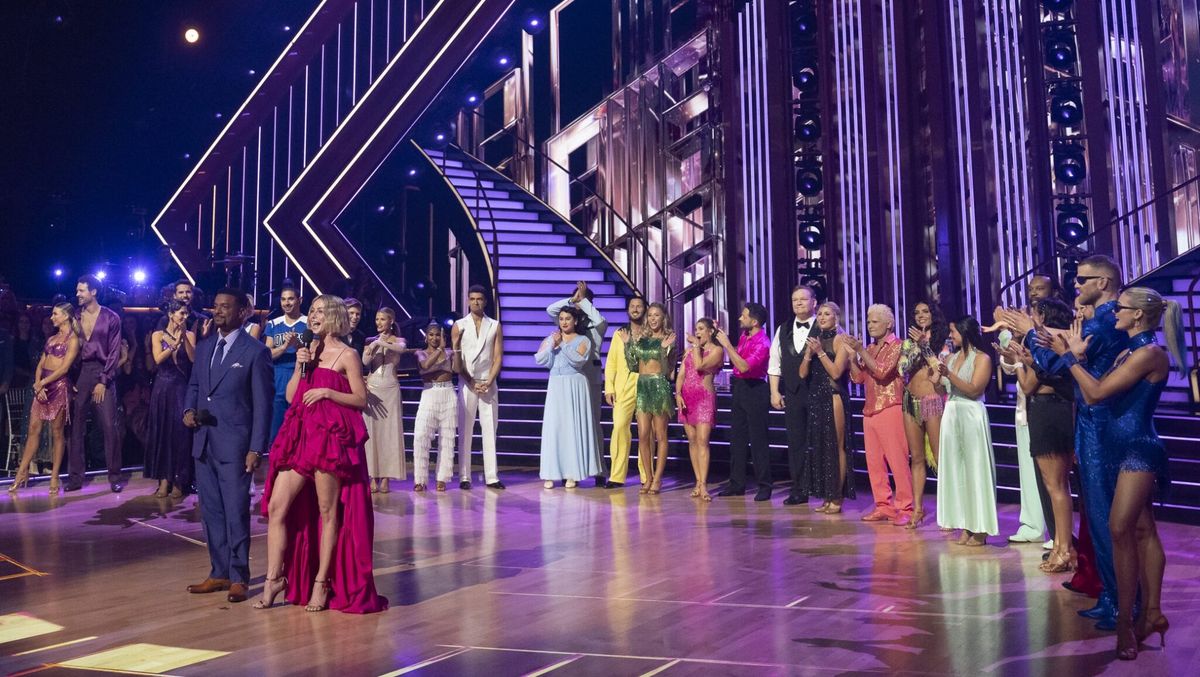
Dancing With the Stars is borrowing the scale, soundtrack and competitive mythology of America's biggest sporting event for a television first. On Tuesday, October 13, the ABC ballroom becomes “Super Bowl Night,” sending the 11 remaining Season 35 couples into routines built around songs made famous by halftime-show performers. It is a theme designed to bridge two enormous audiences: viewers who follow every scorecard in the ballroom and fans who treat the Super Bowl halftime show as a pop-cultural event in its own right.
The episode airs from 8 to 10 p.m. Eastern on ABC and Disney+, with next-day streaming available on Hulu. Another couple will be eliminated before the night ends, reducing the field to ten as the season moves toward Dedication Night. The football connection extends to the judging table, where veteran broadcaster Joe Buck joins Carrie Ann Inaba, Derek Hough and Bruno Tonioli as guest judge.
That combination gives Week 5 a sharper identity than a routine theme episode. The celebrities are not simply dancing to popular records. They are working with music already attached to some of American television's most replayed performances — Rihanna, Lady Gaga, Shakira, Usher, Bruno Mars and Bad Bunny among them. Every routine therefore arrives with a ready-made comparison in the viewer's mind, even though the couples must translate stadium spectacle into ballroom technique.
AN NFL CROSSOVER WITH REAL DWTS HISTORY
Super Bowl Night also brings former NFL players and Dancing With the Stars alumni back into the room. Emmitt Smith, Donald Driver, DeMarcus Ware and Danny Amendola are scheduled to appear, connecting the current cast with a long-running relationship between the competition and professional football.
Smith remains the landmark figure in that history. The Hall of Fame running back became the first NFL player to win the Mirrorball trophy in 2006, partnering with Cheryl Burke in Season 3. Driver later won Season 14, while the show's football contestants have repeatedly demonstrated why athletic experience can help without making ballroom success automatic. Balance, stamina and comfort under pressure transfer well; frame, musical phrasing and partner connection still have to be learned.
Buck's presence adds another layer to the crossover. He is known for describing pressure rather than awarding points for it, and the role of guest judge asks him to read performance through a different vocabulary. His value to the episode is less about pretending to be a ballroom technician than recognizing composure, momentum and the ability to deliver when an event has been framed as larger than an ordinary week.
THE SONG LIST TURNS HALFTIME HISTORY INTO BALLROOM ASSIGNMENTS
The lineup moves quickly across pop, hip-hop, Latin music and R&B. Maura Higgins and Mark Ballas have the tango, set to Rihanna's “Only Girl (In the World).” Higgins enters the episode with momentum after earning the season's first score of nine during Mariah Carey Night. A tango gives the partnership a chance to convert that confidence into precision: strong shaping and attack will matter as much as the song's familiar rush.
Jenna Dewan and Val Chmerkovskiy will perform a paso doble to Lady Gaga's “Bad Romance,” a pairing that makes immediate theatrical sense. The paso rewards dramatic lines and controlled intensity, while Gaga's record already carries a visual language of sharp poses and high fashion. The danger is obvious, too. A routine this naturally matched to its song can feel prepackaged unless the couple supplies detailed technique beneath the spectacle.
Olympic skater Amber Glenn and Pasha Pashkov take on a samba to J Balvin and Willy William's “Mi Gente.” Glenn's skating background gives her speed and spatial awareness, but samba's grounded rhythm demands a different relationship with the floor. The assignment is a useful test of whether elite movement experience can be reshaped rather than merely displayed.
Julia Stiles and Ezra Sosa will dance jazz to the Track Masters remix of Jennifer Lopez's “Jenny from the Block.” Jazz gives them stylistic freedom, but that freedom raises expectations for character and clarity. Tatyana Ali and Jan Ravnik have a salsa to Kendrick Lamar's “squabble up,” a choice that asks them to find ballroom structure inside a track not written to hand dancers an obvious traditional template.
The men's assignments lean heavily toward Latin styles. Paralympian Ezra Frech and Daniella Karagach will salsa to Nelly's “Hot in Herre.” Connor Wood and Rylee Arnold have a samba to Shakira's “Hips Don't Lie,” while Jackson Olson and Emma Slater take on a salsa to Mark Ronson and Bruno Mars' “Uptown Funk.” Guillermo Rodriguez and Witney Carson will salsa to Bad Bunny's “Tití Me Preguntó,” one of the most current cultural references in the lineup after Bad Bunny's 2026 halftime performance.
Harry Shum Jr. and Jenna Johnson will samba to Usher's “Yeah!” featuring Lil Jon and Ludacris. Shum's professional dance experience gives him one of the clearest technical advantages in the field, but the competition still requires him to fit that experience to a defined ballroom style and a partner-led routine. Tyler Cameron and Sharna Burgess close out the announced slate with jazz to the Black Eyed Peas' “The Time (Dirty Bit).” Cameron is coming off his best score of the season, a 21 out of 30 for his Mariah Carey Night foxtrot, so the question is whether a looser style can preserve that progress.
MAURA HIGGINS GIVES THE NIGHT A UK STORYLINE
For British viewers, Higgins is the clearest point of connection. The former Love Island UK contestant has moved from reality television into an American live competition where audience voting matters alongside judges' marks. Her partnership with Ballas also carries a curious bit of television continuity: the pair appeared in the previous season of The Traitors, so Super Bowl Night is not their first shared experience inside a high-pressure unscripted format.
Higgins' early nine last week makes her one of the night's most closely watched performers. Yet a strong score can be as complicated as it is encouraging. It changes the expectation from improvement to consistency, and viewers will now judge her tango against a standard she helped set. The transatlantic interest around her gives the episode reach beyond its football theme, particularly among UK fans following how a familiar personality adapts to an American entertainment institution.
WHY THE THEME MAKES BUSINESS SENSE
The timing is not accidental. ABC and ESPN are scheduled to carry Super Bowl LXI on February 14, 2027, placing the game inside the same wider Disney television portfolio as Dancing With the Stars. A ballroom tribute months ahead of the broadcast lets the company start linking music, football and live-event television before the NFL postseason begins.
That corporate alignment does not automatically make the episode compelling, but it explains the care put into the guest list and music choices. The best DWTS themes give casual viewers an easy entry point while still producing meaningful tests for the contestants. Super Bowl Night offers both: famous songs for viewers dropping in and sharply different dance styles for those tracking technical growth.
It also reflects how the halftime show has evolved. The performance is no longer treated as a short interruption in a football game. It is a global music showcase whose costumes, surprise guests and set lists drive a parallel entertainment-news cycle. By building a full ballroom episode around that archive, Dancing With the Stars is acknowledging that the Super Bowl now contains two spectacles with overlapping but distinct audiences.
THE COMPETITION CANNOT GET LOST IN THE SPECTACLE
Last week's elimination is the reminder beneath the celebration. Summer House star Ciara Miller and Brandon Armstrong left after earning 21 points for their jazz routine on Mariah Carey Night. The result reinforced a basic truth of the format: a respectable judges' score is not enough when viewer support is part of the outcome.
That makes Tuesday's episode unusually volatile. Recognizable music can help a contestant make an immediate connection, but it can also encourage choreography that chases a halftime-show impression instead of the assigned dance. Couples who balance those demands — honoring the song's cultural memory while showing clear ballroom content — are likely to make the strongest case to both judges and voters.
The night should also clarify the shape of Season 35. Five eliminations have already narrowed a broad opening cast, and the remaining celebrities now have enough performances behind them for improvement to be measured rather than imagined. Some will arrive with athletic or dance experience; others have built their appeal through personality and visible effort. A high-concept episode compresses those different strengths into two hours and makes every weakness easier to see.
Super Bowl Night is therefore more than a promotional crossover. It is a smart pressure test at the point when the competition needs to separate memorable contestants from genuine contenders. The songs are famous, the guest list is built for event television and the ballroom will be dressed for scale. By the end, however, the familiar rules still apply: technique must survive the spectacle, the partnership must sell the story, and one couple will discover that even a stadium-sized theme cannot protect them from elimination.